The Cosmic Mirror
What we are actually looking for when we look up. An essay on space exploration, the philosophies built around it, and the suspicion that the void mostly hands us back our own reflection.
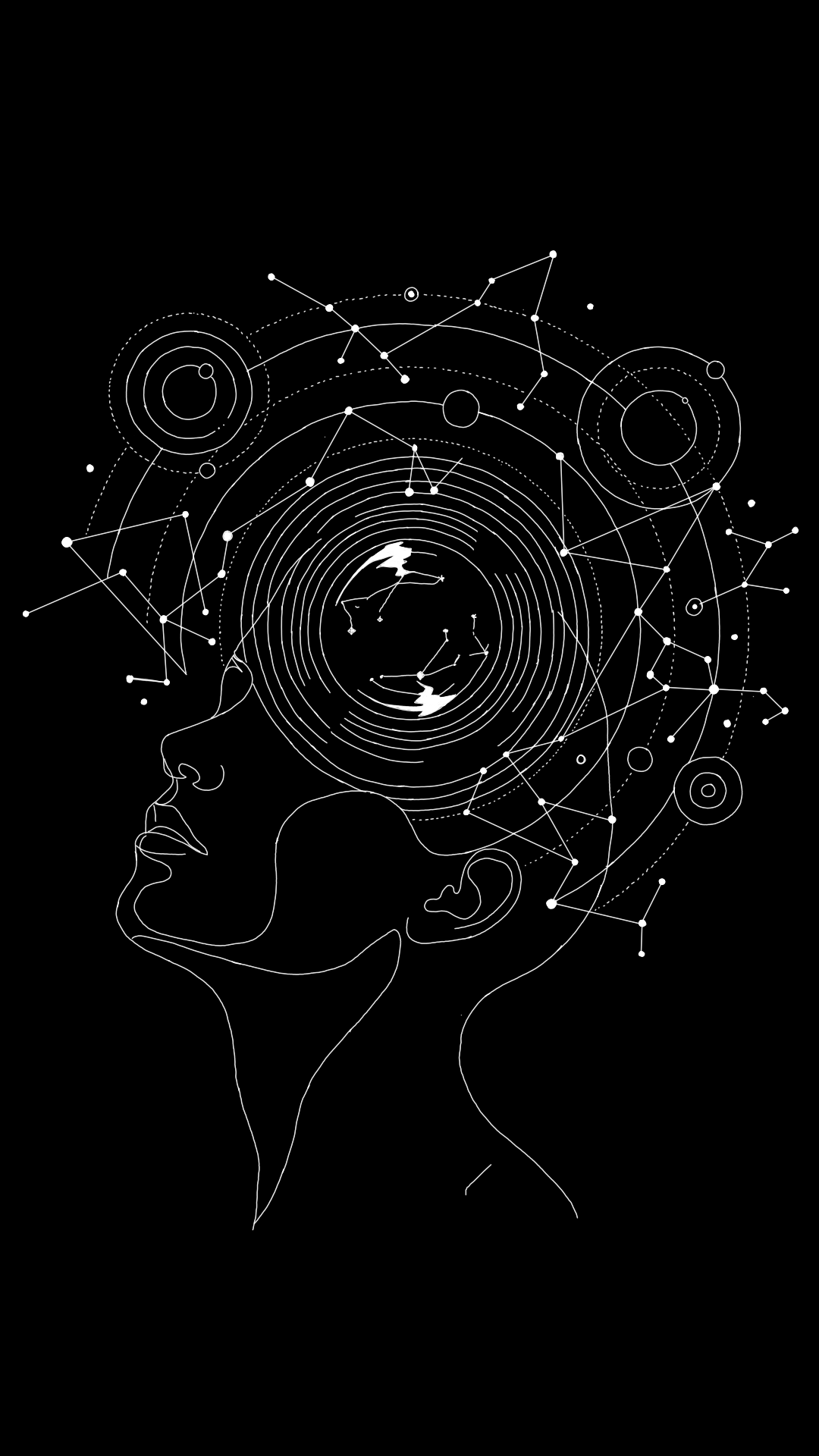
We are creatures of soil. Gravity shaped us, an atmosphere wraps around us, and every part of our inheritance is tied to one wet planet. And yet for as long as there have been human eyes, they have gone up, toward the empty freezing dark, which by any sensible reckoning has nothing in it for us at all.
The night sky was never only cold gas and burning fusion. It was a mirror. We put our gods up there, and our empires, and the things about ourselves we could not otherwise say out loud.
Why we look up
In the ancient world the heavens were where order lived. Above was the realm of the divine; below was decay and accident and mortality. To look up was to look for a grammar that might make sense of what happened down here.
Science did not empty that gaze of meaning, it changed its direction. When Galileo turned his telescope on the moon he did not simply find craters. He broke the wall between the corrupt earthly sphere and the perfect unchanging heavens. Once that wall was down, the cosmos was no longer another category of thing. It was an extension of our own physical reality, which meant it was, in principle, a place we could go.
The compulsion to leave the atmosphere says something that engineering and geopolitics do not explain. We are defined by the capacity to imagine what lies past the edge of what we can sense, and by treating every edge as a provocation. We will go and see what is over the next hill even when the hill is a crater on a dead world a hundred million miles away.
The refusal of death
That drive found its most extreme statement in Russian Cosmism, a movement of the late nineteenth century led by an eccentric librarian named Nikolai Fedorov.
Fedorov held that humanity's moral duty was to defeat death by scientific means, physically resurrect every ancestor who had ever lived, and settle the cosmos. Death was not a natural part of life. It was a design flaw, a form of entropy we were obliged to overcome. And the space part followed with a certain logic: if every generation who had ever lived were brought back, the Earth would overflow. Settling other worlds was therefore not a fantasy but an ethical necessity.
Bizarre as this sounds, it laid the foundations of actual spaceflight. Fedorov's disciple Konstantin Tsiolkovsky worked out the rocket equations that eventually put us in orbit, and produced the line everyone still quotes: the Earth is the cradle of humanity, but one cannot live in a cradle forever. Tsiolkovsky expected us to outgrow our biology altogether and enter a radiant era of pure energy as immortal citizens of the universe.
The Cosmist lineage gives away something about the whole project. Our ambitions in space are bound up with our terror of death. We look at the stars as a sanctuary, somewhere our achievements might outlast the decay of the planet that produced them. There is an irony in that. In trying to defeat entropy we project our hubris onto a universe that never asked for it, rather than accepting that what we are is temporary, fragile, and entirely dependent on the soil we want to leave.
Arendt, and the view from outside
Against the Cosmists stands Hannah Arendt, who was not impressed.
In The Human Condition she argued that our cosmic ambitions might amount to a form of earth alienation. The moment we could look at our planet from outside it, we cut an old and necessary connection to our own sensory reality. What we adopted instead was the view of a detached mathematical observer, which abstracts human life into equations and in the process drains it of anything that was actually lived.
For Arendt the astronaut is not the freest human being who has ever existed. He is the most exiled. Sealed in a capsule, he is cut off from every earthly element that made him what he is. To survive out there he has to carry a miniature synthetic copy of the Earth with him: its atmosphere, its water, its food. Every breath is mechanically managed. Direct contact with the actual environment outside means instant death. The logical inhabitant of that expanse is not a man at all but a cyborg, half organism and half machine.
There is a real tension in this. Trying to escape a terrestrial prison, we built a smaller and more artificial one and climbed inside. Arendt's point was that the stature of man is not raised by our ability to measure the stars. It is lowered when we trade the shared world of human relationships for an exile managed by instruments.
Camus, and the silence
To go into space is to meet, without any of the usual padding, what Albert Camus called the Absurd: the friction between a human heart that wants meaning and a universe that answers with an unreasonable silence.
On Earth we can hide from that silence. We have work, and social arrangements, and cultural stories, and they fill the day. In the corridors of the cosmos the silence is total. There is no air to carry sound, no life to reflect a thought back, and no gods anywhere among the rocks of Mars.
Camus would not have called launching rockets into that silence futile. He would have called it rebellion. We know the universe is indifferent to us. We know our probes will end as dead metal drifting in an entropic sea. We build the machines anyway. We calculate the trajectories, we send the signals, we write the poetry. Sisyphus knows the boulder will roll back down and pushes it up the mountain regardless, and our work in space is the same gesture: a refusal to let consciousness be argued out of existence by the sheer scale of everything else.
We do not find meaning waiting for us in the stars. We make it in the act of looking.
Solaris
The dream is nearly always described as a search for contact: the hope of meeting another intelligence and learning that we are not alone.
Stanisław Lem took that hope apart. His characters orbit a planet covered by a single sentient ocean that refuses every scientific category brought to it. For close to a century human researchers study it, building elaborate theories, and they never once establish contact. The ocean stays alien, indifferent to their frameworks and deaf to their signals.
Snaut, in a moment of drunken honesty, says the thing the whole novel is built on: we have no real interest in discovering genuinely alien worlds. What we want are mirrors. We want to extend the borders of the reality we already know, and find civilisations we can classify, trade with, or conquer. We travel to the stars carrying earthly questions, and we are frightened of a reality that will not fit our models.
When the ocean does eventually answer, it does not use radio. It materialises physical phantoms out of the scientists' repressed guilt and grief. Lem's cosmos is not a blank surface waiting for our footprints. It is a mirror, and what it reflects is our own internal mess.
Andrei Tarkovsky's film moves the emphasis off spaceflight entirely and onto the inner landscape of the people. It ends with the protagonist kneeling before his father in the rain, on an island the alien ocean has synthesised: the warm, sensory world of home, rebuilt out of memory. Set against it, the station with its sterile corridors is revealed as a monument to loneliness.
The view from orbit
This is not only a literary idea. It happens to people who have actually looked down.
The philosopher Frank White named it the Overview Effect: the shift that occurs when an astronaut sees the planet hanging in blackness. From up there the national borders that feel so solid at ground level are simply not present. What is present is a single thin integrated system, a blue oasis in an enormous hostile nothing, protected by a layer of atmosphere no thicker than a skin.
The experience is not straightforwardly joyful. It often arrives as grief. William Shatner went to the edge of space expecting adventure and came back overwhelmed by sadness. Looking out, he did not see a playground for future colonies. He saw cold, hostile, terrifying blackness, and death. Looking down, he saw warmth and life. The universe was a graveyard, and the small planet underneath him was the only sanctuary in sight.
That shift exposes the gap between our ambitions and our performance. From orbit the Earth is a borderless home that obviously requires collective protection. The moment the astronauts land they are back among national sovereignty and geopolitical conflict, all of which remain entirely real. We look outward hoping for an exit. The Overview Effect suggests the actual value of going is that it forces us to see how urgently we need to learn to live here.
The language of the frontier
The vocabulary gives the game away. Almost every word we use about space is inherited from imperialism and settler colonialism. We talk about colonising Mars, conquering the high frontier, exploiting the resources of the moon and the asteroids.
That is not loose metaphor. The language carries a framework with it, one that treats nature as a passive dead object to be dominated and extracted for profit. It shows up in how we describe celestial bodies now: not as environments with any value of their own, but as blank slates for corporate extraction and planted flags. The commercialisation of low Earth orbit threatens to reproduce the worst habits of earthly capitalism somewhere new.
We are already leaving marks. The space around the planet holds tens of thousands of pieces of orbital debris: abandoned rocket stages, dead satellites, fragments that endanger everything launched after them. We take our waste with us wherever we go, which is as clear a statement as any about our capacity to live within a limit.
There is a contradiction inside our own planetary protection rules. Space agencies write strict prohibitions against contaminating other worlds, and our presence on those worlds makes contamination unavoidable. Build a habitat on Mars, mine the moon for water, drop a probe into the frozen oceans of Europa, and something pristine is disturbed by definition. It is worth asking whether we have any right to export our unresolved conflicts and appetites into the quiet dark.
The conscious speck
The journey outward turns out to be a journey inward. We build the telescopes and launch the fragile probes not to dominate the stars but to work out where we stand among them, and the cosmic mirror does not show us a landscape waiting to be settled. It shows us ourselves: fragile, brief, and worth something anyway.
We are made of stardust, assembled from elements forged in the hearts of dying suns, which means that through our curiosity the universe has arranged a way of looking back at itself.
The most remarkable thing is not the scale. It is not the billions of light years or the endless burning. It is that somewhere inside all that indifference, on a minor planet, a small and fragile species became conscious enough to look up and ask what any of it means. That capacity for wonder is the real measure of us. We do not have to conquer the cosmos to matter. We matter because we can ask, and feel the awe, and go looking for meaning in a universe that hands out none.
Our reaching outward is not an escape from being human. It is the completion of it. In stretching toward the stars we are turned back toward the soil, and made to understand that the Earth is not a launch pad to be discarded but the only sanctuary we have. The starry sky above and the moral law within were never two separate realms. They are two faces of the same mirror, and what looks into it is a conscious speck that, for its brief moment, stares into the infinite dark and decides to make its own light.
Sources
- Hannah Arendt, The Human Condition, including her essay The Conquest of Space and the Stature of Man.
- Nikolai Fedorov, Philosophy of the Common Task.
- Albert Camus, The Myth of Sisyphus.
- Stanisław Lem, Solaris.
- Frank White, The Overview Effect: Space Exploration and Human Evolution.